
Cripple. History Major. Irritable and in constant pain. Vaguely Left-Wing.
- 100 Posts
- 68 Comments
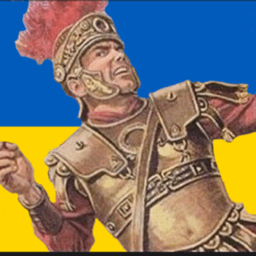
Explanation: Nestor Makhno was the de facto head of the anarchist faction in Ukraine during the Russian Civil War after the overthrow of the Tsar, and then the overthrow of the leftist elected government which succeeded the Tsar (it was a chaotic time).
Makhno was a very skilled military leader - having been involved in action against both Russian and Austrian imperialists for over a decade - and an idealist whose behavior was largely laudable and inspiring. This meme, however, is about a minor curiosity - that when he reconnoitered enemy positions, his preferred disguise was to dress as a woman. Who would expect the 'ard feared military commander in a shawl and a dress, after all!
Based femboy Makhno hours
Explanation: After the formation of Israel, there was a great deal of tension in the Arab states. Israel, having come in and settled a minority ethnicity in an Arab-majority territory until they were populous enough to agitate for an ethnostate, and expel/ethnically cleanse many of the native Arabs, a genocide which is still ongoing to this day, was not popular in the Arab world, for reasons that should be obvious.
After an initial failed attempt to eject Israeli settlers in the 1948 Arab-Israeli War, there was a brief period of cold peace. Israel, for its part, put effort in this period into intentionally agitating the Arab states and stoking pre-existing antisemitism (which, to be fair, was not-inconsiderable), with the end result of a mixture of government policy in the Arab states and popular discontent driving out hundreds-of-thousands of Arab Jews from these countries… right into the waiting arms of Israel, which accepted all Jews as migrants. This nearly fucking doubled Israel’s population at the time, greatly increasing its ability to resist economic and military pressure from the Arab states.
One suspects that it was not the best move, morally or strategically.
Explanation: Julius Caesar is sometimes regarded as the man who destroyed the Roman Republic. This is a… contentious position for numerous reasons, not least of which being the extreme dysfunction caused by the conservative faction (Optimates) of the Republic.
They were surprisingly materialistic about building to adjust for climate shaping people! The Roman writer Vitruvius cites that very reason - of environments shaping people - in his work De Architectura (‘On Architecture’) for why buildings in different latitudes should be subtly changed to let more or less sun and wind in.
There wasn’t any precision to it, mind - just a vague sense of ‘less than is in Africa’ and ‘more than is in Britannia’ - but they thought they were changing the material conditions to be appropriate for bringing up GOOD ROMAN CITIZENS
There were non-climate related reasons as well - the Romans believed that environment in all things shaped people, not just physically but mentally (itself not an absurd position to take - what we would recognize as cultural environments), which is why they put great emphasis on building very Roman cities in similar latitudes as well. Straight roads aligned with the breeze, trees planted for shade, good access to public spaces and water - things that Rome itself, an unplanned city, ironically did not always have, lmao.
Explanation: Both Aristotle, an ancient Greek, and Ibn Khaldun, a Medieval Arab, expressed the view that people to the north and the south of their respective homelands were, in some way, inherently deficient, and incapable of self-governance.
For bonus points, the Romans had a similar view, though with the caveat that Romans believed that as the ‘difference’ (Romans blamed the sun drying up too much/too little blood in the body) was caused by the environment, it could also be counteracted by the environment - ie if you make your cities in distant northern or southern locations REALLY Roman, then only a little of that dastardly too much/too little sun will infiltrate into the GOOD, EVEN, MODERATE folks who grow up there! Hence part of the reason why Roman colonies in Africa look fucking near-identical to ones in Italy other than the surrounding landscape.
Explanation: Dixie is a pre-Civil War Southern tune. During the US Civil War, it became popular as an unofficial anthem of the pro-slavery Confederacy, while the anti-Confederacy North dropped a fire variant for liberating the South from anti-democratic slaver shitheads.
If you hum Dixie, and it is a good tune, be careful that no one mistakes you for the wrong kind of Dixie enjoyer!
As Abraham Lincoln himself said, slightly tongue-in-cheek, at the conclusion of the war…
I have always thought `Dixie’ one of the best tunes I have ever heard. Our adversaries over the way attempted to appropriate it, but I insisted yesterday that we fairly captured it. I presented the question to the Attorney General, and he gave it as his legal opinion that it is our lawful prize.
Explanation: In the 19th century AD, Europeans flooded inland into the continent of Africa, formerly largely closed off to them by difficulty of travel and supply, seeking to colonize and, secondarily, to convert to Christianity whomever they could find. The African country of Ethiopia, however, which retained its independence in the face of 19th century European aggression, had been Christian for longer than most of Europe had been - Ethiopia had adopted Christianity in the 4th century AD!
Explanation: One of the key scientists in the construction of early codebreaking computers in WW2 was Alan Turing (yes, of Turing Test fame), a gay man. While it was not immediately after WW2, in the 1950s, he inadvertently admitted to a cop that he was homosexual when being interviewed about a burglary at his house (cops, even on the occasions they are useful, are NOT your friends). His key work in defeating the literal fucking Nazis was disregarded in favor of chemically castrating him after he pled guilty to the charge.
It is suspected that this was a major cause of his subsequent suspected suicide by biting into a cyanide-laced apple (though some still hold that the apple incident was an accident).
Explanation: In the first two Punic Wars between Rome and Carthage, Rome took massive losses, repeatedly, and continued to send their generals out - sometimes even the same fucking ones - to fight again.
By contrast, whenever Carthage had significant losses - or just needed a scapegoat, as in the case of Hannibal Gisco (no relation to the more famous Hannibal Barca) - their generals were recalled and executed.
The two most notable Roman incidents which come to mind are in the First and Second Punic War, respectively.
In the First Punic War, a Roman admiral disregarded the sacred omens, tossing the augur’s birds into the fucking ocean for giving an omen not to fight, and then lost the subsequent battle, along with thousands of Roman seamen. When he returned to Rome in shame, he was stripped of his command and basically told not to show his face in polite society again (which supposedly did not stop his wife from publicly making jokes about how she wished he’d drowned more of the filthy Roman plebs).
In the Second Punic War, after quite literally the most devastating loss in Roman history, the Battle of Carrhae, the defeated commander, having fell for the brilliant Carthaginian general Hannibal Barca’s trap and lost tens of thousands of Roman troops in the process, returned to the city of Rome… where he was greeted with acclaim for not killing himself in shame, because every man was needed in the fight against Hannibal.
Explanation: As the Roman Empire expanded to become massive and wealthy in the 2nd century BCE-1st century AD, the formerly rough society of farmer-soldiers was exposed to all sorts of new and exciting luxuries - like spices, perfumes, and S I L K. This, to Roman moralists, was CORRUPTING and FOREIGN and would make Rome WEAK and EFFEMINATE. One Roman writer during the Empire, if memory serves, bitches about women in public wearing silk so thin that it was see-through.
Of course, such bitching about THE CORRUPT AND LUXURIOUS YOUTH is as old as society itself, and had a long history in Roman writing as well - dating back to at least the written works of Cato the Elder after the Second Punic War, wherein he condemns such dangerous Gr*ekoid notions as ‘literature’ and ‘doctors’ as foreign and unsuitable for REAL Romans. Scipio Africanus, savior of the Republic, on the other hand, was a noted Graecophile.
Funny enough, the Roman conqueror and dictator Julius Caesar was noted as something of a dandy himself, taking great care of his personal appearance, having his body hair plucked, and always being on the cutting edge of fashion. Caesar once said in regards to the license he allowed his troops, that “They would fight just as well if they reeked of perfume”.
Explanation: Mark Antony, one of Caesar’s close allies, was considered crude and something of a boor by his fellow Romans, and never showed any hint of the genius - political, cultural, or military - that Caesar did. Yet after Caesar’s death, Mark Antony managed to snare the extremely well-educated and cultured Egyptian queen Cleopatra first as his lover, then as his wife. One supposes she saw some manner of charm in him that his fellow Triumvirs lacked! Though Mark Antony was noted as having sexy legs, and wearing scandalously short tunics to show them off…
Fun Fact: It’s generally accepted that most flowery ancient pre-battle speeches are full of shit. A few which have survived, in whole or in part, which are considered reliable are generally short and sweet. Generals would need them to be so, since the most reliable way of imparting the speech would be to repeat it several times, each time before a group of a few thousand troops.
As Napoleon once noted, “It is not that addresses at the opening of a battle make the soldiers brave. The old veterans scarcely hear them, and recruits forget them at the first boom of the cannon. Their usefulness lies in their effect on the course of the campaign, in neutralizing rumors and false reports, in maintaining a good spirit in the camp, and in furnishing matter for camp-fire talk.”
How about now?
I mean… no? They erupted in response to the purge of the Girondins, which wasn’t very revolutionary.
The Girondins who were purged for being too far-right for the Jacobins’ tastes? The Girondins who promptly made common cause in the Federalist Revolts with literal royalists?
Unless you define the revolution to mean Paris, fighting against authoritarian centralisation of power seems very in line with the Revolution even if the leadership of the revolts did tend to have conservative sympathties.
Interpreting the French Revolution, an incident sparked by the demands of a national congress for national standardization of representation in a centralized system, as anti-centralization is a very curious take; dismissing the conservativism of the leaders of the opposition is even more curious.
That’s… uh… wow. You should revisit the French Revolution and surrounding wars, seriously.
Are we going to ignore the deep interconnected nature of both the European aristocracy and the monarchist regimes of each polity?
For reference, though, the civil war was based in pretty legitimate grievances against Paris authoritarian overreach,
The overwhelming objection was not that Paris’s power was centralized - a matter they were more than happy to support when it suited them - but that the regime in Paris was too radical for their tastes.
Like Confederates barking about “States’ rights”, all it ever really meant was “We aren’t in power and we don’t like that”.
the purge of the Girondins for the Federalists
The purge of the Girondins was a triggering event, but not the basis of the Federalist revolts, which occurred overwhelmingly by the support of the wealthy bourgeoisie which felt the Revolution had gone ‘too far’, in concert with royalist counterrevolutionaries.
and religious oppression+conscription for the Vandee folks.
“Religious oppression” here meaning “Not allowing theocracy to continue”. Sadly something a great many people regard as religious oppression - as seen in Christofascists in the US, and Islamists in Turkiye.
As for the Revolutionary wars, France literally declared war first; everyone else wanted it to collapse in silence so they could focus on Poland. Neither of these were significantly affected by the aristocratic sour grapes.
The threat to declare war was openly and freely made first by the anciens regimes, and armed bodies of emigres not only allowed, but supplied and supported as they built their forces on the borders of France.
Explanation: In the aptly named Crisis of the Third Century, the Roman Empire was on the verge of literal disintegration. The frontier province of Illyricum (the modern day Balkans), combining both a high degree of assimilation into Roman culture and a pre-existing warrior society, provided a great many recruits for the Roman military, including several so-called ‘barracks emperors’ with military backgrounds.
They were not ready to give up on the dream that was ROME!
Wasn’t the main thrust of the regime disposing of political opposition of all kinds? I don’t think the Federalists were killed because they were reactionary, and the victims of the immediate aftermath of the Lyon revolt alone outnumber Terror victims in Paris.
… the Federalists and Lyon revolts were literally reactionary, though.
were the aristocracy or clergy really the established ruling powers? In 1789 sure, maybe even 1790, but by late 1793, let alone early 1974, I think these guys were clearly the former established ruling powers, so I still think alluding to the Terror doesn’t imply a threat to still-in-charge ruling powers. The credit for actually deposing the aristocracy, which was an almost entirely peaceful affair, goes to money (or the lack thereof), the aristocracy (and not in a “bad decisions” kind of way) and the liberal bourgeoisie, respectively.
Considering that the aristocracy and clergy still held immense power, to the point of rallying a continent-wide coalition to reinstall them as well as a civil war to help them along?
I feel very comfortable saying that their execution was the execution of an established ruling power, and that “Government offices are no longer officially monopolized by them for a whole two years” doesn’t really change that.


Bro
Explanation: The Molotov-Ribbentrop Pact was a ‘non-aggression’ pact between the Soviet Union and Nazi Germany which outlined carving up Eastern Europe between the two polities. In accordance with the pact, the Soviet Union invaded Poland with Nazi Germany in 1939.
Soviet apologists often claim that it was ‘just’ a non-aggression pact, which raises the question why the fuck they were assisting Nazi Germany genocide Poland, and why the pact involved carving up the Baltic states. The Soviets would go on to supply Nazi Germany with important war materiel until 1941, when the Nazis invaded the Soviet Union.