

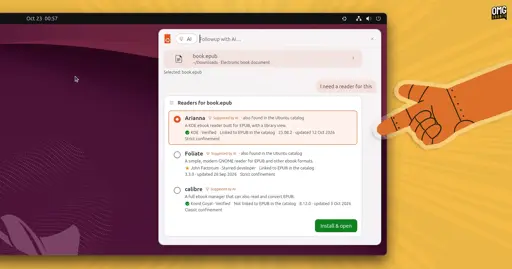
A Canonical engineer has published a prototype launcher that simulates how on-device AI could be used to enhance and aid users of the Ubuntu desktop.
But the warty-prototype1 snap by Didier Roche-Tolomelli (aka didrocks) is not a real launcher. It’s a semi-interactive, automated mockup. It simulates things a user could do, and that includes interacting with a (theoretical) on-device AI model to complete tasks.
True but a system like that wouldn’t just rely on the model training. It’d also rely on the harness around it. The program that takes the text from the clanker’s output and executes it. It can have, as existing tools do, a hefty static ruleset that allows / disallows / asks for user confirmation before executing. The ruleset would have to be significant and well designed to catch most disasters. Still wouldn’t be foolproof, but neither are my own CLI commands, or my brain at all times of the day. A not-so-reliable operator can be further mitigated by using a snapshotting filesystem.
Yes the harness is what i was talking about.
You can get footguns also from your own cli commands, misunderstanding the documentation, or by copy/pasting from a guide without knowing what you’re doing. But in both those cases it is clearer that it is your responsibility for understanding the context. And eventually that’s how you learn.
A generative, agentic system that does things for you without you needing to understand, and gets it right a lot of the time, but trains the user to enter the sudo password wihout understanding is not the UX I would encourage in an operating system.
True.